
Fallson
On Baby Steps
I've been picturing him as he might appear if ever glimpsed from far below. Cresting the tree line, coming into and out of focus through some documentarian's telescopic lens, where the effect might be a little more inquisitive, a little less judgmental: what is he, and what's he up to, up there? Maybe it would reify the remove between us and him: the scraggly, unkempt hair, his one foot self-conspicuously suspended in front of the other, looking like a Sasquatch silhouette bumper sticker. But this particular Missing Link fills a space in the evolutionary scale somewhere between Couch Potato and Homo Erectus, driven from his natural environment (the mancave) by his besieging parents. Now exposed, conspicuous, nothing seems to come naturally to him, from the moment he first wriggles out from the water, Tiktaalik-like, stands upright, and immediately keels right over his ankles.
Poor bastard, it turns out he's another malformed escapee from Dr. Foddystein's grotesquerie. He's an experiment, like the potted forearms-and-torso the game developer contrived for Getting Over It, or the the body of the eponymous QWOP, whose legs and thighs one could twitch via alternating currents of the Q, W, O, and P keys of the keyboard, and who in practice ran with more fits and starts than a fainting goat. Our newest protagonist/prototype, Nate, seems to have come down with his own bad case of the QWOPS.[[1]] His arms, those would-be trophies of his evolutionary inheritance, hang from his shoulders as limply as plumb-bobs, and he walks by voluntarily electing, with every single step, precisely how high to lift his foot and where to throw it ahead of him.
But these are exercises in anatomical isolation, as much video games as they are quasi-educational exhibits of the kind I would have played with at Liberty Science Center.[[2]] With Baby Steps, it's a leg day again, and Nate, spiritually transported from his couch to a hilly Purgatorio, must QWOP his way out, through mud and up mountains, stumbling and sliding and periodically falling back to the bottom, using only his lower half. Trip at some vertiginous height, and Nate won't reach out to try to stop himself from plummeting a few flights or worse: slumping into strategically annoying couloirs of mud that funnel him even further down, or pinwheeling off of outcroppings like that one guy that hit the propeller in Titanic. When he finally comes to a rest, he briefly lies as if dead, sometimes draped dramatically across stone like the Christ of the Pieta—though he'll always get up groaning, nothing actually harmed except pride and my own personal opportunity costs. What can you do? Hoist him upright and start again from the bottom, pushing those twin boulders of his backside uphill once more with rhythmic nudges of the triggers.
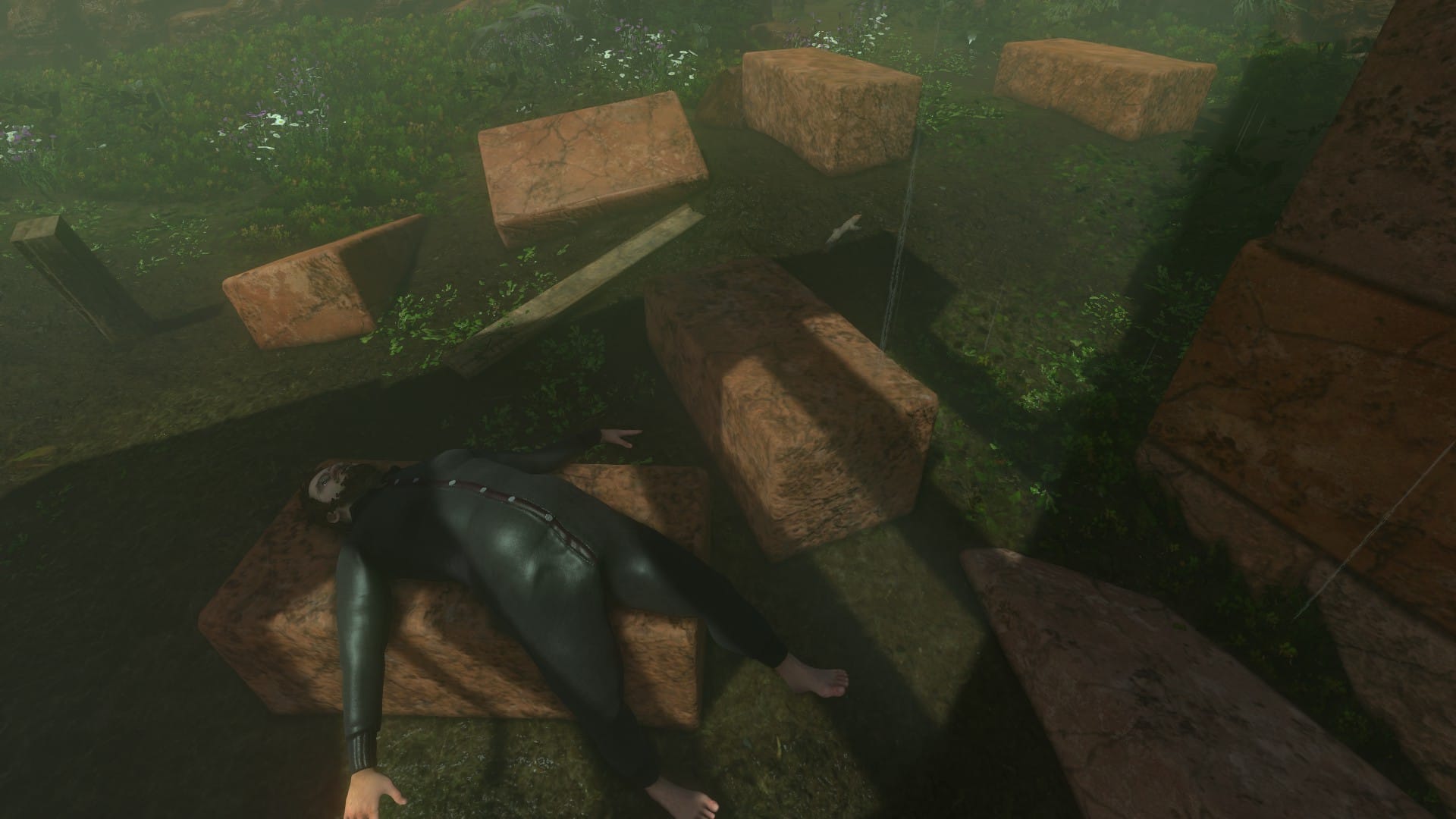
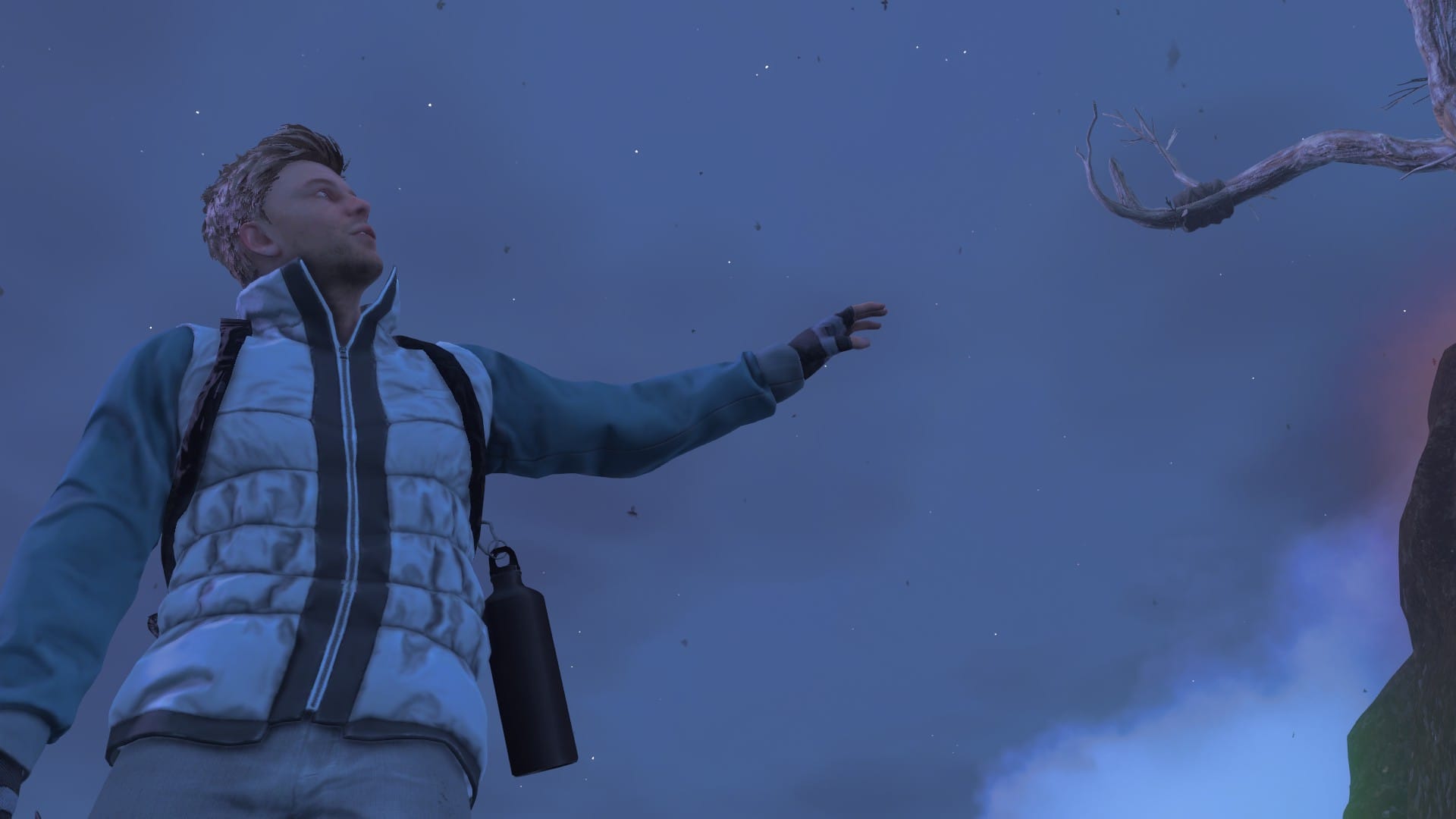
Even if he were physically capable of lifting a hand to help put an end to his own debasement, Nate hardly seems inclined. Instead he tucks in, embracing the schneid, moaning resignedly as he goes over cataracts or inexplicably crumples mid-move. I've seen the fucker seemingly push himself away from the rock face, as if to better to gain momentum for his plunge. Even on mild falls, he'll melodramatically huck any objects he's carrying off the side, forcing you to decide how much you really needed them. But nothing's worse than those moments when it looks like he's finally slowing down after a long slide and he'll seem to hesitate—as you beg him Nate, stop, please, not here, not today—only to then impertinently dip over another precipice, accelerating like a golf ball on a fast green.
Resentment would naturally brew between anyone given such circumstances. That's before we even consider Nate the man, a failure-to-launch of such SpaceX proportions that I wouldn't trust him to light the bong that has pride of place on his coffee table. As befits the name of the thing, Nate is blatantly toddler-coded, from his onesie to his plaintive whimper, regularly offered to random people he meets, that he needs to pee. On the few occasions he does use his hands, it's only ever to grasp for objects he wants before they're properly within reach, the way a child does (which is, yes, another regular source of his spills).
And yet, Nate regularly spurns help—refusing offers of shoes, advice, even a lantern when entering a cave—in an ongoing bit that goes from funny to exasperating to hilarious. I was initially unsure how much of this to ascribe to timidness, and how much to obstinance. But it becomes clear that the developers (Foddy's co-conspirators this time are Gabe Cuzzillo and Maxi Boch) view this as a distinction without difference. Consider how Orson Welles famously described Woody Allen of having "that particular combination of arrogance and timidity [that] sets my teeth on edge. Like all people with timid personalities his arrogance is unlimited. Anybody who speaks quietly and shrivels up in company is unbelievably arrogant...a man who presents himself at his worst to get laughs, in order to free himself from his hang-ups. Everything he does on the screen is therapeutic."
Welles may have a point. Therapeutic, heck—Nate's limbo is straight-up Freudian. Various objets d'arrested development (trophies, sandcastle pails, ice cream cones) intermix with Oedipal fixations (a nude woman made of sand, rivulets of breast milk that flow from mammarian mounds in the landscape, his overprotective mother's beckoning voice, just out of reach). Nate crosses paths with a few human men, such as Jim and Mark, would-be guides that Nate manages to quickly refashion into foils. But most of the world's other residents are a supernumerary of half men-half-donkeys, their junk conspicuously dangling between their upright legs. I suppose that makes the place the Land of Toys/Pleasure Island (The Adventures of Pinocchio/Disney's Pinocchio, respectively), befitting a utopia where manchildren give themselves over to play that blurs into labor. They taunt Nate, dangling their tools (figurative and literal) in his face. "Just grapple it with your grappling hook," Mark sardonically advises, looking every part Better Off Dead-après-ski, as Nate contemplates another daunting chasm what needs crossing.
In Getting Over It, Foddy's aesthetic conceit was a kind of bricolage: if a bus stacked on top of a space shuttle happened to produce an appealing profile for climbing, well then so be it. This suited a game that was, essentially, an extended, vertical obstacle course. But encountering a lone carousel horse near the start of Baby Steps, I was initially worried that a similar approach here would come off as only so much towered Unity Engine slop, ultimately indistinguishable from other jerry-rigged, stream-ready climbing games like the viral hit (and asset theft crime scene) Only Up!. But Baby Steps' world is more thematically cohesive...or perhaps it's better to say its various distractions are more deliberately draped. Sometimes the mountains Nate climbs are mountains, but just as often they're sandcastles, replete with oversized plastic pail and shovel, or cardboard box forts. I tried to climb the carousel horse all the same; waste of twenty minutes, but it seemed the thing to do at the time.
The dominant mode is dramatic bathos, rhetorical anticlimax, what-have-you. Reach the top of a tower that you're (suspiciously) forecautioned holds nothing, and after a few hours and an incredibly difficult climb you find at its summit...nothing. The soundtrack, such as it is, swells to accompany this action not with strings or brass, but with a cacophony of barnyard sound effects and Bop-It! stings. Nearly every aspect of the presentation is sending up, with ironic gusto, the notion of deriving any sense of achievement from a video game. And yet, I see a cardboard box with a smiley face drawn on it, held aloft at the top of a precarious cairn of other cardboard boxes, and I inevitably resolve, to borrow from Mark Twain and his "Genuine Mexican Plug," that I will own that cardboard box helmet, or die.
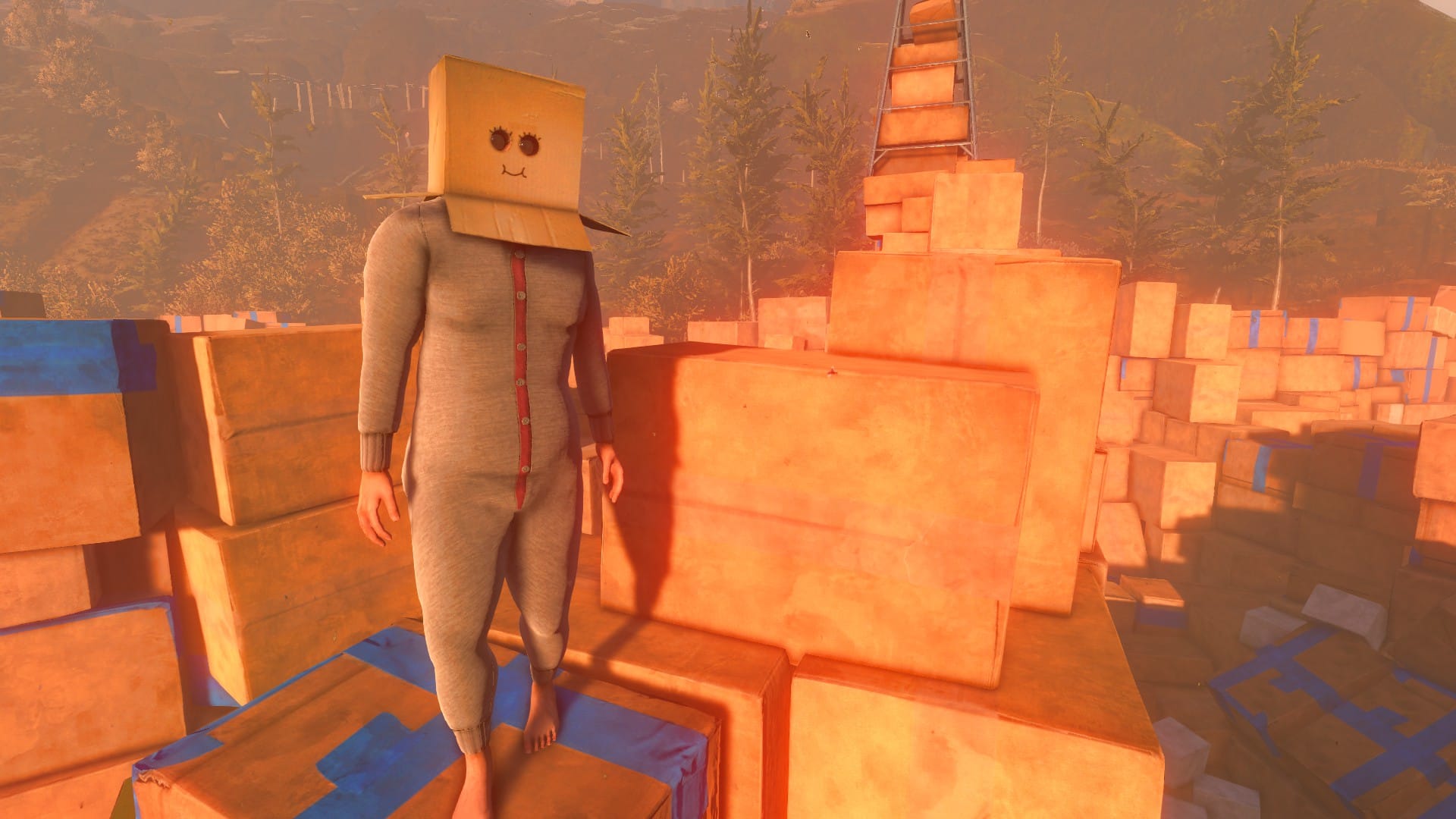
The game gleefully stokes this impulse. Possibilities are often hinted from afar at that up close turn out to be slippery, impracticable mirages. But once you've chosen them as a goal and perhaps even made a bit of hard-fought progress towards them, that's when Nate's ankles begin miring in sunk-cost fallacy. This is, of course, much to the delight of the developers. Interviewed for Wired, Foddy describes watching one player stubbornly insist on trying to climb one of the very mud chutes designed to send the player back downwards. "The playtester’s “intense need to climb that mudslide—it's funny to me, it's gratifying as a designer,” says Foddy. “I loved that he was doing it. Like, that's not productive.”" As the same piece goes on to note: "Baby Steps...entreats gamers to examine how much they unconsciously adhere to damaging masculine ideas including an unwillingness to appear weak or incapable, whether that’s in how well they play a game or how willing they are to sometimes take the L. It makes its hero less like the muscled protagonists of games past and more like them: unhelpfully stubborn types with what Foddy calls "slightly problematic" views of what it means to succeed that are actually holding them back."
Cut to me, at the time of writing and months after starting the game, still somewhere on the Manbreaker, one of Baby Steps' principal challenges. It's a long, arduous climb with several trip-ups right at the last stretch...which also happens to have an adjacent staircase that players have no good reason not to take instead.[[3]] I have not taken the stairs, may very well die having not reached the top of this thing. Why am I still clinging to the side of this thing? Perhaps there's some profundity at work. Perhaps I've fallen straight into the metatextual trap. Perhaps it was my Blogger's Instinct that suffering is the surest way that one can attain true Content. Perhaps it's my Dantean punishment for my habit of quoting myself about death in a Souls game canonically being really a matter of "a playthrough being frozen in time, like one of those bodies on Mt. Everest."[[4]]
At least I'm in good company. As Brendan Sinclair recently put it:
I have not finished Baby Steps and I'm not sure that I will, but I have had a very personal and intimate experience with it. This feels in opposition to the accepted wisdom: that this is the sort of thing designed to play with an audience.
I'm not quite so committed to the solo experience as Brendan, though as a fellow Old, my mental image of ideal communal gaming here would harken all the way back to the couch of my off-campus house. I imagine someone running downstairs into the basement and interrupting a game of beer pong to say "Nick's going for the Manbreaker," in the same way Mouse says "Neo's fighting Morpheus."
"Psh, he's been at that for weeks and he hasn't gotten past fucktown."
"He passed fucktown 5 minutes ago." [Everyone runs upstairs].
But Sinclair isn't wrong: there's something inherently isolating about climbing. This can be in spite of the presence of others, or even heightened by their participation, in the way of a vision quest—everyone experiences it, but your experience of it will be your own. While Nate and I were on the Manbreaker (and even if I wasn't actively on it, mentally, I was still on it) I was also on social media, trying to intellectualize my predicament by noting how this particular climb must surely produce the kind of intimacy that would lead to players nicknaming its various sections (hence "fucktown," above). Foddy and his playerbase preceded me there, of course; while doing live commentary on a playthrough of Getting Over It he once casually remarked "Something like 40% of people don't get past this [section]; they call it The Devils Chimney." I doubt many are thinking about their cohort when they're inside it.
The mountain, of course, is the historic sounding board of so much personal angst. As the developer Paolo Pedercini recently remarked, "the mountain offers a literal learning curve, a clear goal and a visual way to track your progress," It's the quintessence of stubborn, often self-flagellating struggle against implacable nature: man screaming and cursing the mountain as it, heedless, goes on being a mountain. Drama naturally pools in that foggy space between the feat and its risky nonnecessity. So still on the Manbreaker, I went in search of Free Solo for a rewatch.
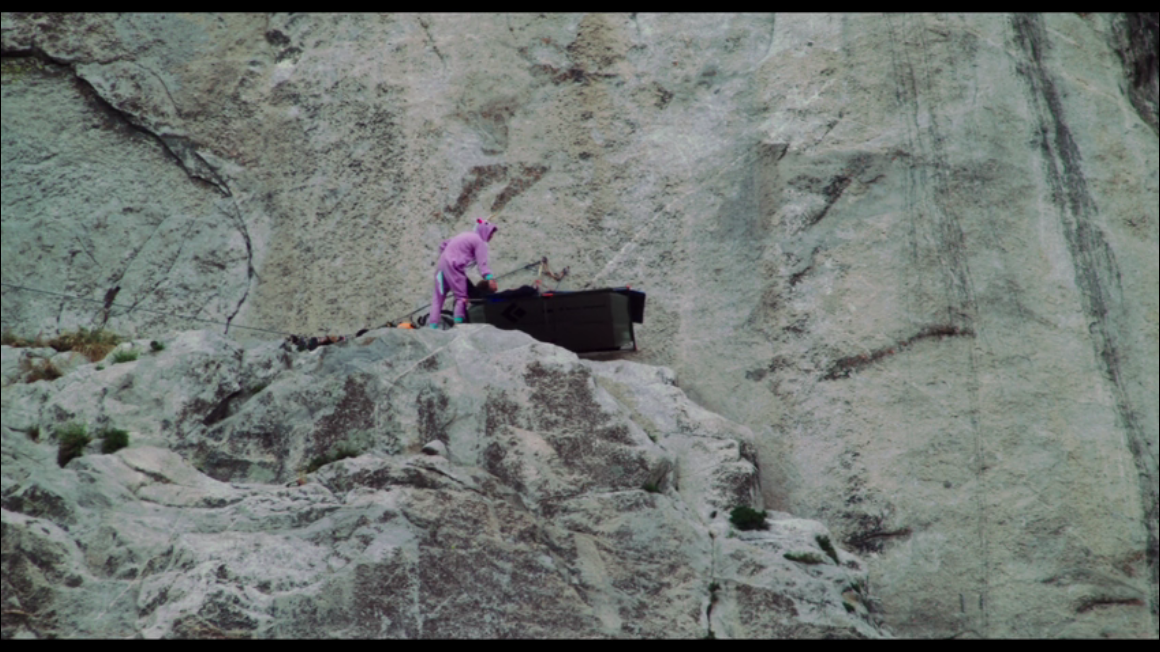
The film documents the rock climber Alex Honnold's preparation and attempt to climb El Capitan, a 3,000' tall sheer granite monolith in Yosemite Valley, "free solo," that is to say: without a safety line. It's likely the most insane individual accomplishment I've ever witnessed, and a nailbiter from start to finish. And what struck me on a second viewing was, yes, gobsmacking awe—but also a renewed surprise at how childish its subject frequently comes off. Honnold casually speculates to the camera about whether his soon-to-be-wife Sanni is a burden that will need to be dropped if he's going to succeed. To her efforts to understand and participate in this major facet of his life and her concerns, he alternates between dismissive and oblivious. After he sprains his ankle falling while the two of them are testing the "Free Blast" section together, Alex confesses that he's tempted to blame Sanni, though nothing suggests she's responsible for the accident. "In terms of learning how to communicate emotion," Sanni tells the camera, "Alex has a long way to go." In one scene, she does an impression of him for some guests they have over for Halloween. "Alex said "I want nothing to do with the pumpkin carving and I won't carve anything and I hate holidays," she mock-pouts. Honnold, missing the social cue to beg-off from what was clearly an earlier argument, replies tweenishly: "I like having fun when I have fun. I don't like being told it's time to have fun." He is 32 at the time.
"No one in any part of my family has hugged during any of my formative years. I had to teach myself how to hug when I was like 23 or something..."that seems like something I should get into" so I started like, [mimes hugging] practicing. Now I'm quite a good hugger." - Alex Honnold, "Free Solo" (2018)
Immaturity or masculine drive? Focus or blithe disregard for others? Are these too distinction without difference? Much to the credit of the directors Vasarhelyi and Chin, I think, Free Solo demurs from facile conclusions that Honnold's impressive abilities directly correlate to his upbringing or his nature (in the movie, Honnold's mother suggests that he is somewhere on the autistic spectrum). But for the viewer who say, wouldn't quite say they're afraid of heights anymore, but definitely doesn't love them and would prefer to stay sensibly away from dangerous ledges[[5]]? The question still dangles precipitously: what separates me from him? Is he a different breed?
I'm an avid watcher of extreme sports clips on Youtube, and below any given Red Bull clip or the like, you'll always find two comments: jokes about the ironic juxtaposition of judging whatever insanely dangerous thing the athlete is doing from the comfort of one's own couch, the other wondering how they're able to, say, climb that tower while weighed down with such big balls. "Nobody achieves anything great because they're happy and cozy," Alex declares, "it's about being a warrior. It doesn't matter about the cause necessarily. This is your path and you will pursue it with excellence." Friends describe him as wearing "armor," when he climbs. The gangly, socially awkward Honnold describes his own free soloing mindset as "pretty close to warrior culture."
We're all intimately, woefully familiar now with the ironies of chauvinism (if I enter "Greg Bovino" in my search bar the first suggestion is "Greg Bovino height"). Chonky CPB agents waddle around Minnesota snowdrifts and wipe out on ice patches. Pete Hegseth holds court in front of far more decorated military members, raving at them about warrior ethos even as he struggles with the nuances of the Guy's Group Chat. The body, we see, does not always cooperate. Consider Trump’s military parade, feared to feature goose-stepping lines of soldiers, and which mercifully turned out to be a much more shambling affair, to the disappointment of those pining for something more Mussoliniesque. Gait, they know, is personal (so much so that surveillance systems may soon identify us by it, as was the subject of a recent bit of NYC legislation). Its free expression defies the fascist call for uniformity, for the totalizing domination of a singular aesthetic. Take Nate, a walking, tripping embodiment of the duality: at a full clip the rigidness of his arms combined with the exaggerated articulation of his legs can sometimes resemble goose-stepping. But he can't help but subvert gender determinism. That same gait, one degree more refined, resolves into something like a stomping Karen, particularly when he clenches his fists at his sides. Often, with his face implacably mashed into some granite rock face, his armless clambering sometimes looks almost Riverdancey.
His comical figure belies exquisite coordination. His body, with its big dumper (I recall a cameraman in Free Solo who, admiring a fissure in the granite mountain, says "That's the most magnificent crack on planet earth"[[6]]), is a walking "Peak Male Performance" meme. And yet standing still, he has in fact a perfect balance that cannot be upset, even in a bladed stance on a 2” wide plank over a 300’ drop. Foddy's surgeons neglected to build any nerves; in this Nate surpasses even Honnold. If, in feeling for a foothold his toe slips, his weight will stay solidly with the remaining foot, providing precious time to cast the other out again. He can hold positively balletic stances, one foot nestled behind the other at an oblique angle. He can shuffle along an edge with only his toes; if I encountered the Thank God Ledge from Yosemite in Baby Steps, I’d think it positively spacious.
In hindsight it seems inevitable that these systems would establish themselves in climbing video games, where fine motor control is afforded attention and a view from a summit is its own reward. If Foddy, Boch, and Cuzzillo sense that this runs against the grain of the hypermasculine fantasy, with its acquisitive model that so rapidly metabolizes ability into increasingly abstracted conventions, I'm inclined to agree with them. Where in the one, our player character is ideally a near-frictionless conduit between us and the demonstration of power, running and leaping and blasting, here, via the deliberate, close frame of climbing, the means are more reciprocal and the ends more humanistic in scale. Sometimes in order to relearn things properly, we have to return to first principles. Of each particular appendage ask, what is it in itself? What is its nature? What does it do?
Well, Nate's little piggies search for toeholds, his ample glutes wobble like a jello mold. He has a wonderful weight to him, so unlike the many video game characters before him for whom the ground plane seems like a matter of convention, a Y value set to zero—and leaning forward he seems to truly plant it, draping his arch across rounded surfaces, and best if the ball of his foot can hook itself over the rougher protuberances. I've learned, when I send Nate's feet out across one of the game's many balance beams, to do it from a top-down view and in a little three-beat waltz: first a gesture towards a direction, then an extension, then a refining of the footfall, 1-2-3...1-2-3...1-2-3. Naomi Clark, the game designer, was recently trying to crowdsource a word for this sort of thing. "In video game simulations," she asked, "what do we call the opposite of abstraction in processes? Where instead of "crafting two things together" with a button press you must enact processes of grinding, attaching, etc? Or what Bennett does with limbs+muscles, instead of just "push forward to move" abstraction? I volunteered "articulation"—the discrete expression of the constituent parts of a system—and I think I'm pretty happy with that as my final answer.
Foddy and Co. have sagely couched their game in the humor of all this, as well as our own cringing disgust, but the Modern Prometheus framework is also a tried and true way of revealing, in relief, what makes us human. If we hold our gaze on those component parts—feet, torso, hands—for long enough, we begin to appreciate the whole.[[7]] How for example, as hapless as Nate is, he doesn't ragdoll, which would be funnier. He has instead a stoic rigidity to him, a quality revealed in his physical failures just as it does in his personality failures. Or for instance, something I intuited long before I consciously registered it: that Nate can't lift his right leg as high as his left, which is the subtle sort of detail that lends a wonderful, latent characterization, as well as a pretty remarkable design decision to make in a game where millimeter differences in how high you lift a leg can mean the difference between a step and a very, very big fall. If we want to make progress, Nate and ourselves, we must make our own affordances.
The game speaks, in these little moments and details, to something else growing before our eyes—a new manner of embodiment, a way of seeing environments and the possibilities of interacting with them. It's like how Peter Croft, another climber in Free Solo, describes Honnold's ascent: "there's incremental advances that happen in all kinds of things but every once in a while there's this kind of iconic leap." I'm thinking of a moment in particular in the cardboard box fort where, in considering a ledge that turned a corner to the left, I opted to try first stepping onto the ledge with my right foot, then pivoting a 3/4 turn on it in the opposite direction—swinging my left leg out into space to wrap it around the corner to the other side, similar to a move that Tom Cruise's Ethan Hunt does while inexplicably free soloing a mountain in the opening of Mission Impossible 2 (a "Reverse Iron Cross," apparently, per Honnold himself, and "so rad."[[8]]). It's not the sort of move you'd expect out of someone like Nate at first blush. But for that matter, not a move you'd expect any video game character previous capable of—not with that level of fidelity to our inputs, anyway. We fell, of course. But what can I say? I was beginning to believe.
[[1]]: Thinking here, of course, of the "The Yips," that sudden attack of nerviness that causes professionals—athletes, primarily—to suddenly and violently forget how to perform the feats of their job. Think Yankees 2nd baseman Chuck Knoblauch famously losing the ability to throw a baseball to 1st, or Jenna on 30 Rock being unable to sing under pressure until Pete wings her with an arrow.
[[2]]: That of the "Iconic Touch Tunnel," which is somehow still operating and somehow still called the Touch Tunnel. While I suppose technically educational in the sense that it too encourages children to attune through sensory deprivation, it was mostly where kids learned whether they were claustrophobic or not; I remember Lincoln Tunnel-esque standstills in that thing when someone up ahead needed to be rescued mid panic attack.
[[3]]: "Men would rather spend a lifetime not-surmounting a pointless video game challenge than go to therapy," etc. etc.
[[4]]: (the streak continues)
[[5]]: A portion of my day job involves hanging off the side of buildings, so it's a case of work necessity proving the better part of valor, here.
[[6]]: One more quote from Free Solo that hits different after having the camera positioned behind Nate's ample asscheeks for 24 hours: "To have the slabs and the Boulder Problem behind him is monumental."
[[7]]: In that sense, Baby Steps is as much an "empathy game" as any other one, isn't it? And considering that it's also a bildungsroman, wouldn't that also make it a Game For Change?
[[8]]: seeing as Nate tried it with only the aid of his feet, I would humbly submit: a "Half Vitrivian."